
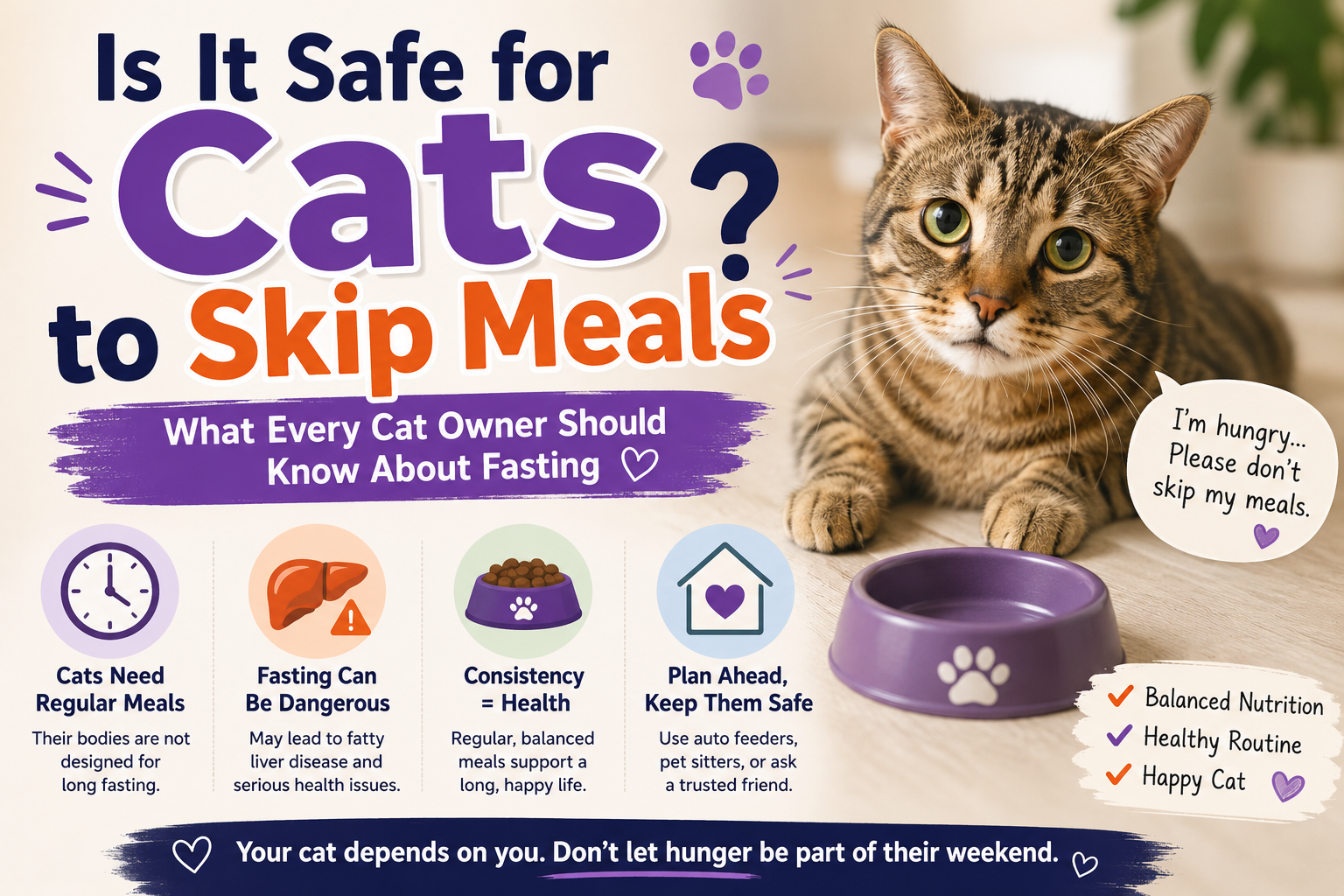
A Cat Behavior and Nutrition Expert Explains the Risks of Missing Meals
Many cat owners occasionally wonder whether it is safe for their cats to go without food for a day or two.
Perhaps they are traveling.
Perhaps they are away for the weekend.
Or perhaps they believe cats can simply "catch up" on eating when food becomes available again.
One common question I hear as a feline nutrition and behavior consultant in the United States is this:
"I feed my cat fresh fish from Monday to Friday, but on Saturday and Sunday I am away from home and my cat does not eat. Is this safe?"
The short answer is:
No, regularly fasting healthy cats for an entire weekend is not considered safe or healthy.
Unlike humans, cats have unique nutritional needs that make prolonged fasting potentially dangerous. While a healthy adult cat may survive without food for a short period, repeated meal deprivation can create serious health risks over time.
In this article, we'll explore what happens inside a cat's body during fasting, the dangers of skipping meals, signs of starvation, safer alternatives, and a real-life story that illustrates why regular feeding matters.
Understanding How Cats Are Different From Humans
Humans evolved as omnivores.
Our bodies can tolerate periods without food relatively well.
Cats are different.
Cats are obligate carnivores.
This means they depend on nutrients found primarily in animal-based foods.
Their bodies are designed to consume multiple small meals throughout the day.
In nature, a cat may hunt and eat:
- Small fish
- Rodents
- Birds
- Insects
A wild cat rarely goes two full days without attempting to eat.
Their metabolism is not designed for extended fasting.
What Happens When a Cat Misses a Meal?
Missing one meal usually isn't dangerous.
Most healthy adult cats can tolerate it.
However, once fasting extends beyond a day, biological changes begin.
The body starts:
- Conserving energy
- Breaking down stored fat
- Reducing activity
- Increasing stress hormones
While this may seem manageable initially, problems can develop surprisingly quickly.
Why Weekend Fasting Is Risky
Let's examine the situation many owners face.
Monday through Friday:
- Fresh fish
- Regular feeding
- Consistent nutrition
Saturday and Sunday:
- No food
- No meals
- No nutritional intake
From the cat's perspective, this pattern creates repeated starvation periods.
Every week, the body enters a nutritional deficit.
The cat never knows when food will return.
Over months or years, this can affect:
- Body weight
- Organ function
- Muscle mass
- Immune health
- Mental well-being
The Hidden Danger: Fatty Liver Disease
One of the most dangerous conditions associated with fasting in cats is hepatic lipidosis.
Often called fatty liver disease, this condition develops when the body rapidly mobilizes fat stores for energy.
The liver becomes overwhelmed by fat deposits.
This can lead to:
- Liver dysfunction
- Severe illness
- Hospitalization
- Death if untreated
Cats are particularly vulnerable to this condition.
Unlike many animals, they do not handle prolonged fasting efficiently.
Even overweight cats are at risk.
Can Cats Survive Without Food for Two Days?
Technically, yes.
Many healthy cats can survive two days without food.
However, survival and health are not the same thing.
A cat surviving a weekend without food does not mean the practice is safe.
Imagine skipping all meals every weekend for years.
The body would eventually suffer consequences.
Cats experience similar challenges.
The Problem With Feeding Only Fish
Another concern involves feeding exclusively fresh fish Monday through Friday.
Fish can be an enjoyable part of a feline diet.
However, fish alone is not nutritionally complete.
Cats require:
- Taurine
- Vitamins
- Minerals
- Essential fatty acids
- Balanced protein sources
A fish-only diet may create deficiencies over time.
Commercial cat foods are formulated to provide complete nutrition.
Fresh fish by itself generally does not meet all long-term requirements.
Behavioral Changes Caused by Hunger
Cats often show behavioral signs when they are hungry.
You may notice:
Increased Vocalization
Your cat may meow excessively.
Food-Seeking Behavior
Cats may search counters and trash bins.
Reduced Activity
Some cats conserve energy.
Irritability
Hunger can increase stress and frustration.
Anxiety
Cats thrive on routine.
Repeated fasting disrupts that stability.
A Story About Milo: The Weekend Fasting Cat
Several years ago, I worked with a cat owner named David.
David owned a handsome gray tabby named Milo.
David worked near the ocean and regularly brought home fresh fish.
Monday through Friday, Milo enjoyed generous meals.
On weekends, however, David often traveled to visit relatives.
Because he assumed cats could manage alone, Milo frequently went nearly two days without food.
At first, everything seemed fine.
Milo appeared healthy.
He greeted David at the door every Monday.
He eagerly ate fresh fish.
Nothing seemed wrong.
Then changes slowly appeared.
Milo became less playful.
He spent more time sleeping.
His coat lost some of its shine.
He appeared thinner.
Eventually, David noticed Milo was not finishing meals.
A veterinary examination revealed nutritional imbalances and early signs of weight loss.
The veterinarian explained that repeated fasting periods were placing unnecessary stress on Milo's body.
David made several changes:
- Automatic feeders
- Balanced cat food
- Daily feeding schedule
- Weekend meal access
Within months, Milo improved dramatically.
His energy returned.
His coat became healthier.
His weight stabilized.
Most importantly, he no longer experienced repeated periods of hunger.
David later admitted he genuinely believed he was helping Milo by providing fresh fish.
He simply didn't realize that consistency was equally important.
Why Cats Need Routine
Cats are creatures of habit.
They thrive on predictability.
A consistent feeding schedule provides:
- Security
- Comfort
- Reduced stress
- Better digestion
When meals disappear every weekend, the routine becomes unpredictable.
This can increase anxiety even if the cat survives physically.
Signs Your Cat May Be Suffering From Inadequate Nutrition
Watch for:
- Weight loss
- Excessive sleeping
- Weakness
- Dull coat
- Increased shedding
- Behavioral changes
- Vomiting
- Reduced appetite
These signs warrant veterinary evaluation.
Is Fish Good for Cats?
Fish offers several benefits.
It contains:
- Protein
- Omega-3 fatty acids
- Important nutrients
Many cats love fish.
However, fish should generally be part of a balanced nutritional plan.
It should not be the only food source indefinitely.
Variety and balance matter.
Better Weekend Solutions
If you must leave home on weekends, safer alternatives exist.
Automatic Feeders
Modern feeders can dispense meals on schedule.
This is one of the easiest solutions.
Family Members
Ask someone to provide meals.
Pet Sitters
Professional pet sitters ensure consistent care.
Balanced Dry Food
Leaving appropriate dry food can help prevent fasting.
Wet Food Schedules
Timed feeders designed for wet food are increasingly available.
How Often Should Healthy Adult Cats Eat?
Most healthy adult cats benefit from:
- Two meals daily
- Three meals daily
- Multiple small portions
Consistency matters more than exact timing.
The goal is preventing prolonged fasting periods.
What About Wild Cats?
Some owners argue that wild cats occasionally go without food.
This is true.
However, wild cats also experience:
- Shorter lifespans
- Higher disease rates
- Greater mortality
Domestic cats benefit from modern care and nutrition.
We should not intentionally recreate survival hardships.
Senior Cats and Fasting
Older cats face even greater risks.
Senior cats may have:
- Kidney disease
- Dental issues
- Reduced appetite
Regular food access becomes increasingly important with age.
Kittens Should Never Be Fasted
Kittens have high energy demands.
They require frequent meals.
Going without food can become dangerous much faster than in adults.
Never intentionally fast kittens.
The Emotional Side of Feeding
Food is more than nutrition.
For many cats, mealtime represents:
- Bonding
- Security
- Routine
- Comfort
Consistent feeding strengthens trust between cat and owner.
What I Recommend as a Cat Nutrition Expert
If your current routine is:
Monday to Friday:
- Fresh fish
Saturday and Sunday:
- No food
I strongly recommend changing it.
A healthier approach would be:
Monday to Sunday:
- Daily food availability
- Balanced commercial cat food
- Fresh fish as a supplement or treat
This approach provides complete nutrition while allowing your cat to continue enjoying fish.
Frequently Asked Question
Can my cat fast every weekend?
No. Repeated weekly fasting is not considered healthy or recommended.
Can a healthy cat survive it?
Possibly, but survival does not equal optimal health.
Is fish enough?
Fish alone is generally not a complete diet for long-term nutrition.
What is the safest option?
Provide balanced nutrition every day, including weekends.
Final Thoughts
Cats are remarkably resilient animals, but they are not designed to endure regular periods of starvation.
If you feed your cat fresh fish Monday through Friday and leave it without food every Saturday and Sunday, your cat may survive, but over time the practice can create significant health risks.
Regular fasting may contribute to:
- Weight loss
- Nutritional deficiencies
- Stress
- Behavioral changes
- Liver problems
The safest and healthiest approach is simple:
Feed your cat every day.
Provide balanced nutrition.
Use fish as part of a complete diet rather than the entire diet.
Remember, your cat depends entirely on you for food, comfort, and security. A bowl of food may seem like a small thing, but to your cat it represents safety, trust, and survival.
When in doubt, imagine how your cat experiences the weekend.
While you're away, the hours pass slowly.
The house becomes quiet.
The food bowl remains empty.
Your cat waits.
And waits.
And waits.
The best gift you can give is knowing that even when you're not home, your cat never has to wonder where the next meal is coming from.