
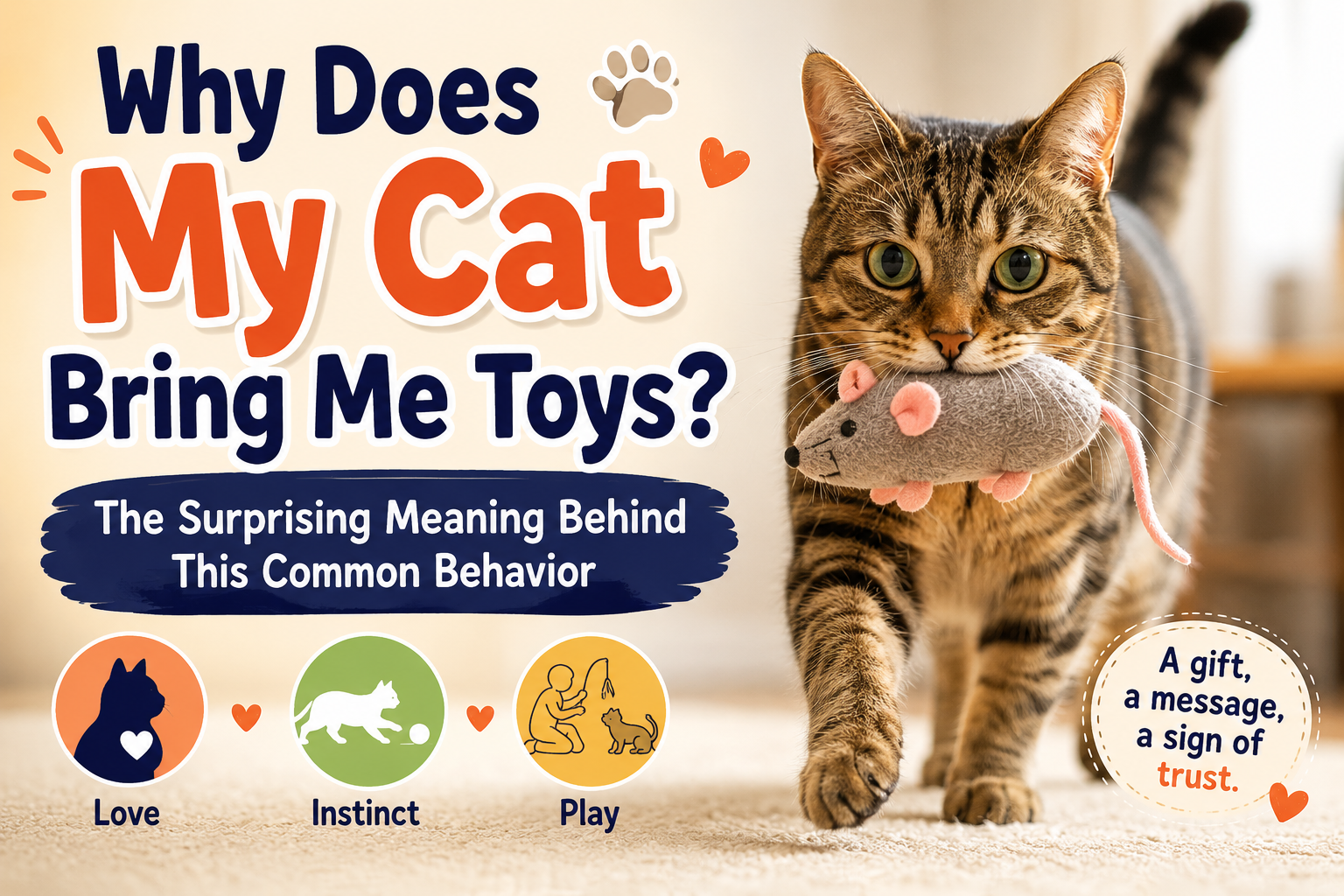
Understanding the Secret Message Behind Your Cat's Favorite Gift
If you are a cat owner, chances are you have experienced a curious moment: you wake up in the morning and discover a toy mouse, a stuffed ball, or a feather wand placed neatly beside your bed. Sometimes your cat proudly carries the toy in its mouth while meowing loudly. Other times, the toy mysteriously appears near your feet while you are working, watching television, or relaxing.
Many cat owners wonder:
Why does my cat bring me toys?
Is your cat trying to share? Is it showing affection? Is it asking you to play? Or is there a deeper instinct behind this adorable behavior?
As a feline behavior specialist with more than two decades of experience studying domestic cats across the United States, I can confidently say that toy-giving behavior is one of the most fascinating ways cats communicate with humans.
The answer is surprisingly complex. Your cat may be expressing love, trust, hunting instincts, social bonding, or even teaching behavior inherited from wild ancestors.
Let's explore the real reasons behind this common cat behavior and discover what your furry companion is truly trying to tell you.
The First Thing to Understand: Cats Communicate Differently Than Humans
Humans often communicate through words, facial expressions, and gestures.
Cats communicate through:
- Body language
- Scent
- Vocalizations
- Physical actions
- Gift-giving behaviors
When your cat brings you a toy, it is not random.
Your cat is sending a message.
The challenge is learning how to interpret that message correctly.
Every toy delivery represents a form of communication.
In many cases, it is actually a compliment.
Your Cat May Be Showing You Affection
One of the most common reasons cats bring toys to their owners is affection.
Cats form strong emotional bonds with people they trust.
When your cat brings a favorite toy to you, it may be treating you as an important member of its social group.
Think of it this way:
Children often share treasured possessions with people they love.
Cats can display similar behavior.
A toy may represent something valuable to your cat.
By bringing it to you, your cat is saying:
"You're important to me."
Many owners notice that their cats only bring toys to specific family members.
This selective behavior often indicates a particularly strong bond.
Your Cat Wants to Play
Sometimes the answer is wonderfully simple.
Your cat wants entertainment.
Cats are natural predators with a strong need for physical and mental stimulation.
When your cat drops a toy in front of you, it may be extending an invitation.
The message might be:
"Let's hunt together."
Cats often associate toys with enjoyable interactive experiences.
If you've previously played fetch or used the toy during play sessions, your cat may have learned that bringing the toy increases the chances of fun.
Common signs your cat wants to play include:
- Excited tail movements
- Chirping sounds
- Repeated toy deliveries
- Running away after dropping the toy
- Looking directly at you
When these signs appear, your cat is likely requesting interaction.
The Hunting Instinct Is Still Alive
Many people forget that domestic cats are skilled predators.
Although they live comfortably indoors, their hunting instincts remain powerful.
Wild cats spend a large portion of their day:
- Tracking prey
- Stalking targets
- Chasing movement
- Capturing food
Indoor cats redirect these instincts toward toys.
A toy mouse becomes prey.
A feather becomes a bird.
A ball becomes something worth chasing.
When your cat successfully "captures" a toy, bringing it to you may be an extension of natural hunting behavior.
In your cat's mind, it has completed a successful hunt.
Now it wants to show off its accomplishment.
Your Cat Might Think You Need Help Hunting
This explanation often surprises cat owners.
Mother cats teach kittens how to hunt.
They gradually introduce captured prey to help kittens develop survival skills.
At first, a mother cat may bring dead prey.
Later, she may bring injured prey.
Eventually, she brings live prey to teach hunting techniques.
Some feline behavior experts believe domestic cats occasionally view humans as inexperienced hunters.
When your cat brings you a toy mouse, it may be saying:
"You seem incapable of catching prey yourself. Let me help."
While humorous, this theory has strong roots in feline evolutionary behavior.
To your cat, you may simply be a very large, somewhat clumsy member of the family.
Why Cats Meow While Carrying Toys
Many owners notice an unusual behavior.
Their cat carries a toy while making loud vocal sounds.
These vocalizations can seem strange or dramatic.
There are several possible explanations.
Excitement
Your cat may simply be excited about its successful "capture."
Attention-Seeking
The meowing helps ensure that you notice the toy.
Social Communication
Cats often vocalize more around humans than other cats.
The meow may be your cat's way of announcing:
"Look what I found!"
Emotional Satisfaction
Many cats appear genuinely proud when carrying favorite toys.
The sounds may reflect emotional arousal and satisfaction.
Why Does My Cat Bring Toys to My Bed?
Beds are one of the most common delivery locations.
There is a reason for this.
Your bed contains your scent.
Cats rely heavily on scent for comfort and security.
Your bed represents:
- Safety
- Trust
- Familiarity
- Emotional connection
By placing a toy on your bed, your cat may be combining two valuable things:
- Its favorite toy
- Its favorite human
This behavior often reflects strong social bonding.
Many cat owners discover toys near their pillow because the cat intentionally chose a meaningful location.
Why Does My Cat Bring Toys at Night?
Cats are naturally more active during dawn and dusk.
These periods are known as crepuscular activity times.
During nighttime hours, your cat's hunting instincts often become stronger.
This increased activity can lead to:
- Toy carrying
- Toy hunting
- Vocalization
- Play invitations
If your cat delivers toys at 3 a.m., it may simply be experiencing a surge of natural predator energy.
Unfortunately, this schedule does not always align with human sleep preferences.
Some Cats Love Playing Fetch
Many people assume only dogs play fetch.
That is not true.
Numerous cats enjoy retrieving toys.
Certain breeds are especially known for this behavior.
Examples include:
- Maine Coon
- Bengal
- Siamese
- Abyssinian
These cats often bring toys repeatedly because they have learned that returning the toy keeps the game going.
The behavior becomes self-rewarding.
For these cats, toy delivery is less about gifting and more about continuing the fun.
The Role of Positive Reinforcement
Cats are excellent learners.
If your response to toy-giving includes:
- Praise
- Petting
- Attention
- Playtime
Your cat may repeat the behavior.
From your cat's perspective, bringing toys produces positive outcomes.
Over time, the behavior becomes reinforced.
This is why some cats become enthusiastic toy couriers.
They have discovered a successful way to interact with their humans.
Why Some Cats Never Bring Toys
Not every cat exhibits this behavior.
That is perfectly normal.
Cats have unique personalities.
Some cats express affection through:
- Head bunting
- Purring
- Kneading
- Following owners around
Others prefer toy sharing.
The absence of toy-giving does not indicate a weak bond.
It simply reflects a different communication style.
Indoor Cats Tend to Bring More Toys
Indoor cats often have fewer opportunities to satisfy hunting instincts.
As a result, toys become important substitutes.
Indoor cats may:
- Hunt toy mice
- Chase balls
- Attack feathers
- Carry plush toys
Because these toys serve as prey replacements, indoor cats frequently deliver them to family members.
This behavior helps fulfill natural instincts in a safe environment.
Why Cats Choose Specific Toys
Have you noticed your cat repeatedly brings the same toy?
That toy likely holds special significance.
Cats often develop preferences based on:
- Texture
- Movement
- Sound
- Size
- Familiar scent
Some cats become attached to particular toys for years.
These toys may function similarly to comfort objects.
Bringing a favorite toy to you can represent a high level of trust.
Should You Reward This Behavior?
In most cases, yes.
Toy-giving is generally a healthy behavior.
You can encourage positive interaction by:
- Offering praise
- Speaking softly
- Playing briefly
- Petting your cat
Avoid punishment.
Your cat is attempting communication.
Punishing the behavior may create confusion and stress.
Instead, recognize it as an opportunity to strengthen your relationship.
When Toy Delivery May Signal Boredom
Although toy-giving is usually positive, excessive toy delivery may indicate boredom.
Watch for signs such as:
- Constant attention-seeking
- Destructive behavior
- Excessive vocalization
- Restlessness
These signs may suggest your cat needs:
- More exercise
- Interactive toys
- Puzzle feeders
- Climbing opportunities
- Additional play sessions
Mental enrichment is essential for feline health.
Creating a More Enriching Environment
As a cat behavior expert, I recommend providing activities that mimic natural hunting.
Excellent options include:
Wand Toys
These simulate birds and flying prey.
Puzzle Feeders
They engage the cat's problem-solving abilities.
Cat Trees
They satisfy climbing instincts.
Window Perches
They provide visual stimulation.
Interactive Play Sessions
Ten to fifteen minutes twice daily can significantly improve well-being.
An enriched cat is often happier, healthier, and less stressed.
What Your Cat Is Really Saying
When a cat brings you a toy, the message is rarely negative.
Most often, your cat is communicating one or more of the following:
- I trust you.
- I love you.
- Let's play.
- Look what I caught.
- I want your attention.
- You're part of my family.
- Let me teach you how to hunt.
Each cat combines these motivations differently.
The exact meaning depends on personality, environment, and life experiences.
A Real-Life Example From My Practice
A family in Texas contacted me because their cat carried stuffed mice into their bedroom every night.
Initially, they worried something was wrong.
After observing the cat, I noticed a pattern.
The toy deliveries occurred shortly before the owners woke up.
The cat had learned that bringing toys often triggered positive morning interaction.
The behavior reflected:
- Affection
- Anticipation
- Routine
Once the family understood the motivation, they began incorporating morning play sessions.
The cat remained happy, and the relationship grew even stronger.
Final Thoughts: Consider It a Feline Compliment
The next time you find a toy mouse beside your pillow or discover a ball placed carefully at your feet, remember this:
Your cat is communicating.
Whether driven by affection, instinct, playfulness, or hunting behavior, toy-giving is usually a sign of a healthy relationship.
Cats do not bring treasured possessions to people they dislike.
In most cases, your cat is offering something meaningful.
It is one of the many unique ways felines connect with the humans they love.
So when your cat proudly delivers its favorite toy, accept the gift with appreciation.
From your cat's perspective, it may be one of the highest compliments it can give.
Conclusion
Why does your cat bring you toys?
The answer combines love, trust, instinct, communication, and play. What appears to be a simple action often reflects thousands of years of feline evolution and a strong bond with you. Whether your cat is inviting you to play, sharing a successful "hunt," or treating you like family, toy-giving is generally a positive sign that your relationship is thriving.
The next time your furry friend drops a toy at your feet, remember that it may be saying something very special:
"You matter to me."