
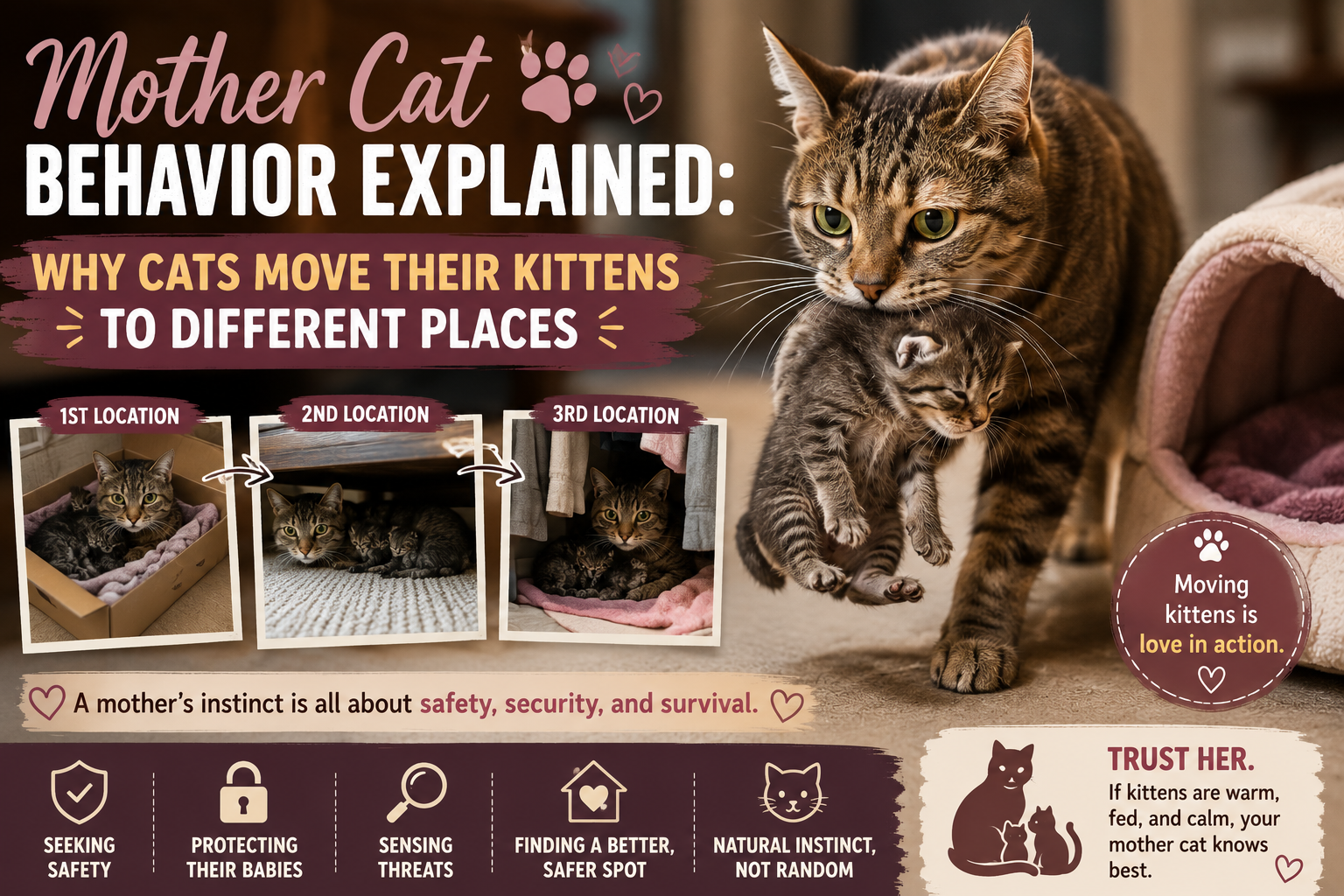
Understanding the Protective Instinct Behind a Mother Cat's Constant Relocation of Her Babies
If you've ever cared for a mother cat and her newborn kittens, you may have noticed something puzzling.
You carefully prepare a comfortable nesting box.
You place soft blankets inside.
You choose a quiet corner of the house.
Everything seems perfect.
Then one morning, the kittens are gone.
A few hours later, you discover them hidden under a bed.
Two days later, the mother cat moves them again.
And perhaps a few days after that, she chooses yet another location.
Many cat owners become confused when this happens repeatedly.
One common question I hear as a feline behavior consultant in the United States is:
"Why does my mother cat keep moving her kittens? She already moved them three different times."
The answer is surprisingly simple:
In most cases, your mother cat is doing exactly what nature designed her to do.
Moving kittens is one of the oldest and strongest maternal instincts in the feline world. While it may appear unnecessary to humans, mother cats often relocate their babies to improve safety, comfort, and survival.
Let's explore the fascinating science behind this behavior and what it means when your cat keeps moving her kittens from one place to another.
The Story That Many Cat Owners Experience
Several years ago, I received a call from a concerned cat owner in Texas.
Her cat, Luna, had recently given birth to four healthy kittens.
The owner prepared an excellent nesting area.
It included:
- Clean blankets
- Fresh water nearby
- Quiet surroundings
- Warm temperatures
For two days, Luna appeared satisfied.
Then something unexpected happened.
The kittens disappeared.
After searching the house, the owner found them hidden behind a couch.
Three days later, Luna moved them again.
This time they were under a guest room bed.
A week later, she relocated them to a closet.
The owner worried something was wrong.
In reality, Luna was displaying completely normal maternal behavior.
Mother cats often move kittens multiple times during the first few weeks of life.
Your experience of seeing a mother cat move her babies three different times is actually quite common.
Why Mother Cats Move Their Kittens
To understand this behavior, we must look at the evolutionary history of cats.
Wild cats face numerous dangers:
- Predators
- Rival animals
- Parasites
- Environmental threats
A stationary nest becomes easier to discover.
Moving kittens periodically reduces risk.
Even though your home may be perfectly safe, your mother cat's instincts remain unchanged.
Thousands of years of evolution continue to influence her decisions.
Reason #1: She Thinks the Original Nest Is No Longer Safe
The most common reason for relocation is perceived danger.
Humans may believe the nesting area is secure.
The mother cat may disagree.
Cats notice subtle details including:
- Strange sounds
- Unfamiliar smells
- Increased activity
- Other animals nearby
If she senses risk, she may immediately move the kittens.
From her perspective, survival depends on caution.
Reason #2: Too Many People Are Visiting the Kittens
Newborn kittens attract attention.
Friends want to see them.
Family members want photos.
Children become excited.
Unfortunately, excessive visitors can stress a mother cat.
If she feels the nest is attracting too much attention, she may move the kittens elsewhere.
Many first-time cat owners unknowingly trigger relocation by checking on kittens too frequently.
Reason #3: She Wants More Privacy
Mother cats prefer quiet environments during the first weeks after birth.
Privacy allows them to:
- Nurse comfortably
- Sleep peacefully
- Bond with kittens
- Recover physically
A location that initially seemed acceptable may later feel too exposed.
The mother cat then seeks a more secluded space.
Reason #4: Temperature Changes
Newborn kittens cannot regulate body temperature effectively.
The mother constantly monitors environmental conditions.
If a nest becomes:
- Too hot
- Too cold
- Too drafty
she may relocate the entire family.
Many owners notice kitten relocations after weather changes.
Reason #5: She Detects Unusual Smells
Cats rely heavily on scent.
Their sense of smell is far superior to ours.
A mother cat may react to odors humans cannot detect.
Examples include:
- Cleaning chemicals
- Perfumes
- Other animals
- New furniture
If a location develops unfamiliar scents, relocation may occur quickly.
Reason #6: Instinct Tells Her to Rotate Locations
Sometimes no obvious problem exists.
The mother simply follows ancient instincts.
In the wild, remaining in one location for too long increases danger.
Moving kittens periodically became a successful survival strategy.
Modern domestic cats still retain this programming.
This is why some mother cats relocate healthy kittens despite ideal conditions.
Reason #7: Other Pets Make Her Nervous
Dogs often trigger kitten relocations.
Other cats can also create stress.
Even friendly pets may unintentionally cause concern.
The mother cat may think:
"My babies need a safer location."
As a result, she moves them.
Reason #8: She Is a First-Time Mother
First-time mothers often behave differently.
They may:
- Relocate frequently
- Appear nervous
- Change nesting areas repeatedly
Inexperience can increase protective behaviors.
Some new mothers move kittens more often than experienced queens.
Reason #9: Noise Disturbs the Nest
Cats prefer calm environments.
Household noises may include:
- Televisions
- Vacuum cleaners
- Loud conversations
- Construction sounds
A mother cat may tolerate these initially.
Eventually, she decides a quieter location is necessary.
Reason #10: She Simply Found a Better Spot
Sometimes the explanation is remarkably simple.
She found a location she likes better.
Cats often choose areas based on:
- Security
- Darkness
- Warmth
- Comfort
What humans consider an inconvenient hiding spot may seem perfect to a mother cat.
Why Some Mother Cats Move Kittens Three or More Times
Many owners become worried when relocations happen repeatedly.
In reality, moving kittens multiple times is often normal.
I've observed mothers move kittens:
- Twice
- Three times
- Four times
- Five times
during the nursing period.
Each move reflects ongoing evaluations of safety and comfort.
As long as the kittens remain healthy, warm, and fed, multiple relocations are not necessarily a problem.
The Amazing Process of Moving Kittens
Watching a mother cat transport kittens is remarkable.
She gently carries each kitten by the scruff of the neck.
This behavior appears rough to humans but is perfectly natural.
The kitten typically becomes calm and still.
This response helps the mother transport her babies safely.
She repeats the process until every kitten reaches the new nest.
Signs the Move Is Normal
Healthy relocation behavior usually includes:
- Calm mother cat
- Well-fed kittens
- Regular nursing
- Clean kittens
- Warm body temperature
- Steady growth
If these conditions exist, the move is likely normal.
When Relocation Might Signal a Problem
Occasionally, excessive moving may indicate stress.
Watch for:
Constant Relocation
Moving kittens daily can suggest anxiety.
Refusal to Nurse
This requires immediate attention.
Aggressive Behavior
Excessive aggression may indicate fear.
Abandoning Kittens
Seek veterinary advice immediately.
Sick Kittens
Weakness or weight loss requires prompt evaluation.
A Real-Life Success Story: Bella and Her Four Hidden Kittens
One of my favorite cases involved a black-and-white mother cat named Bella.
Bella gave birth to four kittens in a laundry room.
Everything appeared perfect.
The family provided:
- Fresh bedding
- Food
- Water
- Quiet surroundings
Three days later, Bella moved all four kittens behind a sofa.
The family returned them to the nesting box.
Bella moved them again.
This time she chose a bedroom closet.
Again, the family relocated the kittens.
Bella immediately carried them elsewhere.
Eventually, I advised the family to stop interfering.
Bella had clearly selected her preferred nesting area.
The family allowed her to remain in the closet.
The relocations stopped.
The kittens thrived.
Within weeks, all four kittens were healthy, active, and growing normally.
The lesson was simple:
Sometimes the mother knows best.
Common Mistakes Cat Owners Make
Returning the Kittens Repeatedly
This creates frustration.
If the chosen location is safe, allow the mother to decide.
Handling Kittens Too Often
Excessive interaction may increase stress.
Moving the Nest Constantly
Frequent changes confuse the mother.
Ignoring Stress Signals
Pay attention to behavioral changes.
How to Create the Ideal Nesting Area
If you want to reduce relocations, provide:
Privacy
Choose a quiet room.
Warmth
Maintain comfortable temperatures.
Low Traffic
Avoid busy household areas.
Soft Bedding
Use clean blankets or towels.
Nearby Food and Water
Keep necessities close.
Even then, remember that relocation may still occur.
Why Mother Cats Are Such Remarkable Parents
Mother cats invest enormous energy into raising kittens.
They:
- Clean them
- Feed them
- Protect them
- Teach them
- Relocate them when necessary
Every decision revolves around survival.
Moving kittens may seem inconvenient to owners.
To the mother cat, however, it may feel like the most important task in the world.
What Your Mother Cat Is Thinking
Although cats do not think in human language, their instincts effectively communicate:
"This place isn't ideal."
"My kittens need better protection."
"I found a safer location."
"We need to move."
These instincts have helped feline mothers successfully raise offspring for thousands of years.
Expert Advice for Cat Owners
If your mother cat has moved her kittens three times, ask yourself:
- Are the kittens healthy?
- Are they nursing normally?
- Is the new location safe?
- Is the mother relaxed?
If the answer is yes, there is usually little reason for concern.
Avoid unnecessary interference.
Support the mother.
Provide food, water, and a calm environment.
Let her maternal instincts guide the process.
The Emotional Side of Motherhood in Cats
Many people underestimate the emotional intensity of feline motherhood.
For several weeks, a mother cat remains constantly focused on her babies.
She sacrifices:
- Sleep
- Personal space
- Comfort
to protect them.
When she moves her kittens, she is not being difficult.
She is responding to one of the strongest instincts in the animal kingdom.
Protection.
Safety.
Survival.
Final Thoughts
Why does a mother cat move her kittens to different places?
Because she is following ancient instincts designed to keep her babies alive.
Whether she relocates them once, twice, or three different times, the behavior usually reflects caution rather than a problem.
She may be seeking:
- Better security
- More privacy
- Greater warmth
- Less stress
- Improved comfort
If your mother cat recently moved her kittens three times, remember that she is likely doing what countless feline mothers have done for thousands of years.
Trust her instincts.
Observe carefully.
Provide a safe environment.
And appreciate the remarkable dedication of a mother cat doing everything she can to protect the tiny lives entrusted to her care.
Because from her perspective, there is no job more important than keeping her kittens safe.